
The year is 2026.
A business owner has an idea.
A platform promises they can build software without developers.
AI will generate the screens.
AI will create the workflows.
AI will write the logic.
The future has arrived.
Three months later, the app is 80% complete.
Everyone is excited.
The login works.
The design looks great.
The forms are beautiful.
There is searching.
There is browsing.
There are even animations.
The future is definitely here.
Then someone tries to pay.
The payment doesn’t work.
Then a customer enters unexpected data.
The workflow breaks.
Then two users do the same thing at the same time.
The records don’t match.
Then the owner asks a simple question:
“What happens if…”
Nobody knows.
Because nobody tested that.
Sound familiar?
Recently, I was brought into a software project after a business had been told they could build their application using AI-powered no-code tools and wouldn’t need technical help.
To be clear, this isn’t a criticism of AI.
And it isn’t a criticism of no-code platforms.
In fact, I use AI every day. It has transformed how our team plans, develops, tests, and delivers software.
The problem wasn’t the technology.
The problem was the expectation.
The 80% Trap
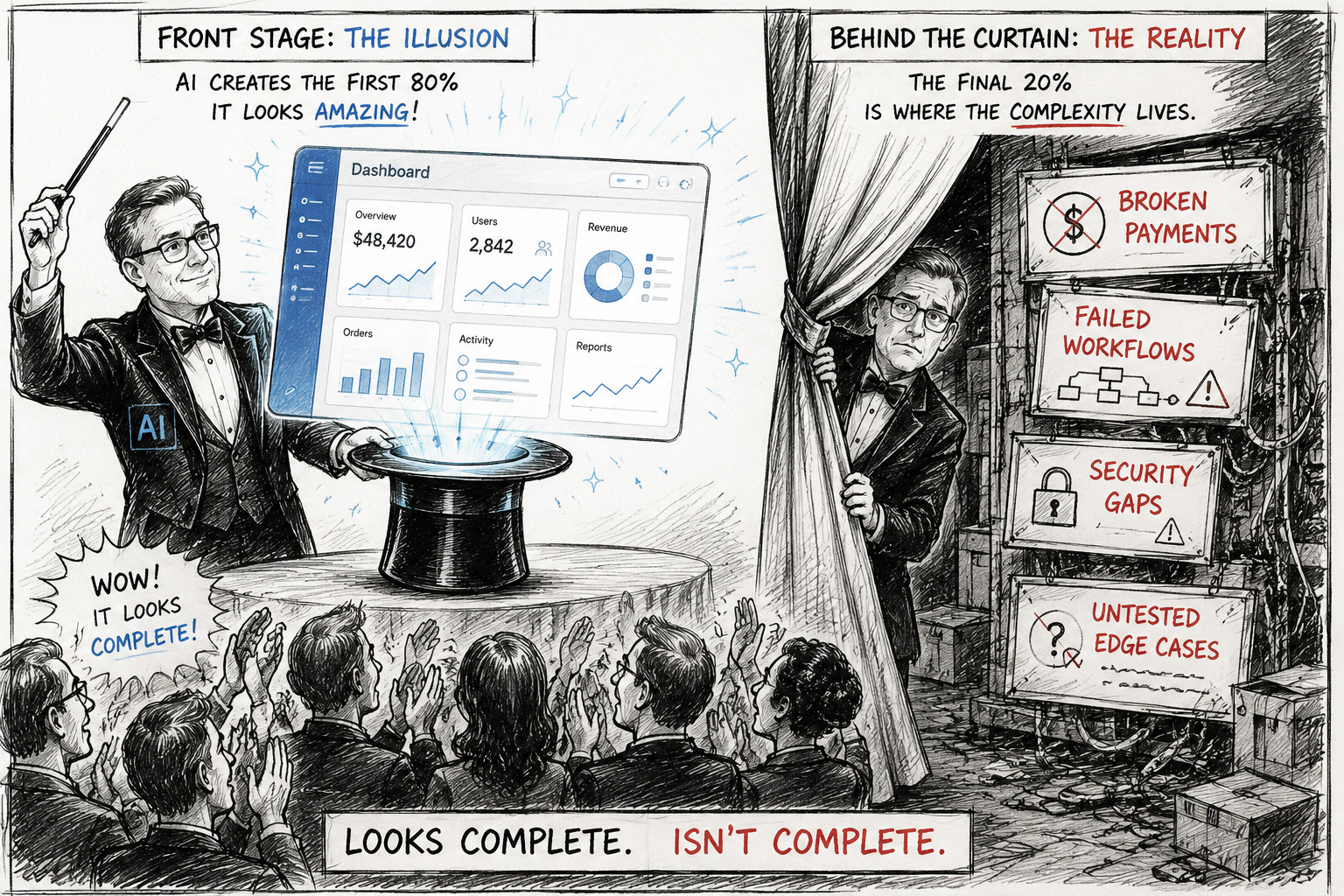
AI is becoming incredibly good at building the first 80% of an application.
It can generate screens.
It can create forms.
It can connect workflows.
It can build dashboards.
It can help create an application that looks remarkably complete in a fraction of the time it would have taken just a few years ago.
That’s impressive.
But it also creates a dangerous illusion.
When something looks 80% complete, most people assume the remaining 20% will be the easy part.
In software, the opposite is often true.
The first 80% is usually the easiest part.
The final 20% is where the complexity lives.
Where Software Engineering Begins
Most users never see the hardest parts of a software application.
They don’t see:
- Payment processing
- Security controls
- User permissions
- Error handling
- Data integrity
- Scalability
- Third-party integrations
- Testing and quality assurance
- Disaster recovery planning
These aren’t the flashy features shown in a demo.
They’re the systems that quietly keep a business running.
When they work, nobody notices.
When they fail, everyone notices.
That’s why software engineering is about much more than building screens and workflows.
It’s about understanding what happens when things don’t go according to plan.
The Questions AI Doesn’t Automatically Ask
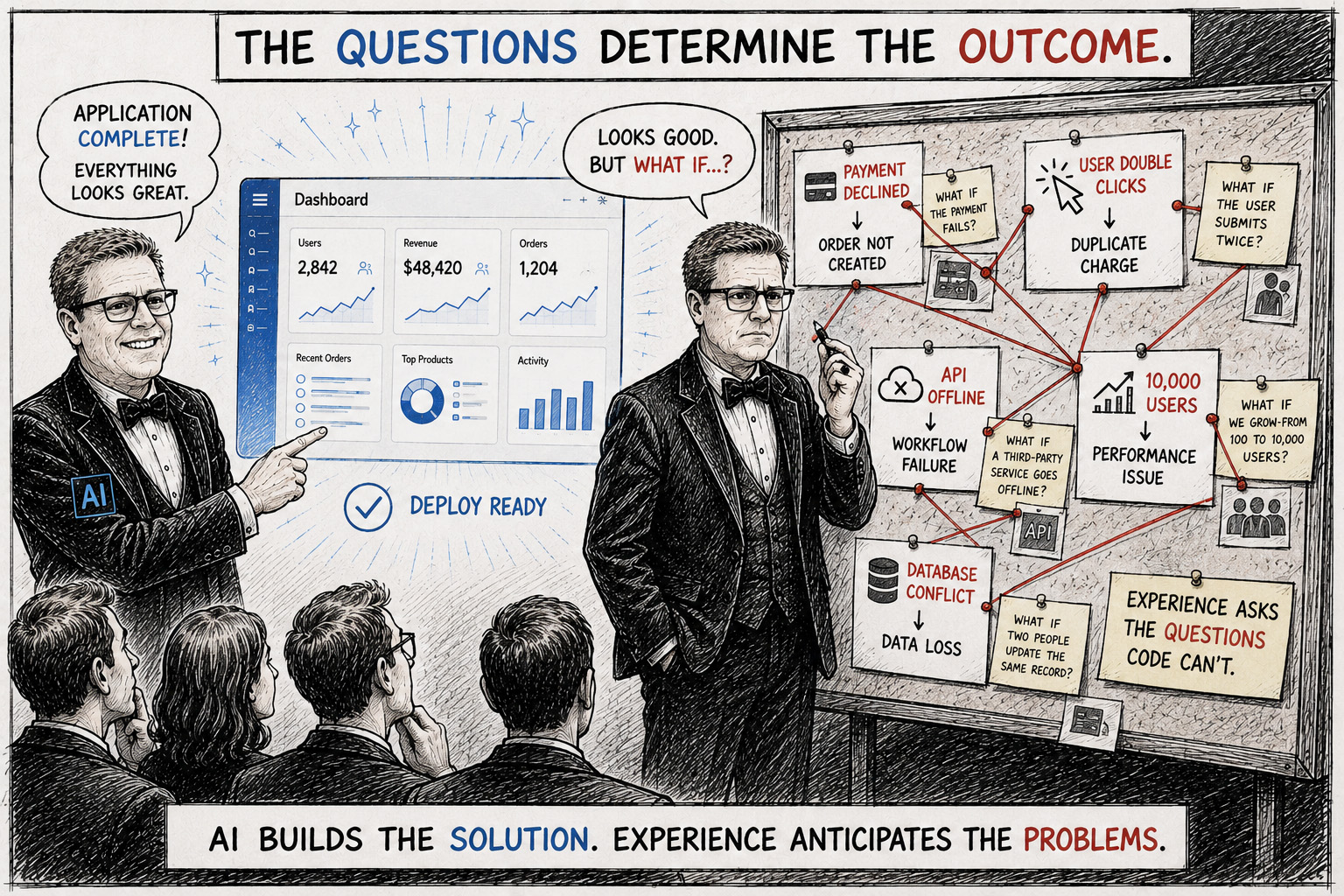
One of the most valuable things an experienced engineer brings to a project isn’t coding.
It’s asking questions.
What happens if the payment processor declines the transaction?
What happens if the user submits the form twice?
What happens if two people update the same record at the same time?
What happens if a third-party service goes offline?
What happens if this application grows from 100 users to 10,000?
These questions often determine whether a project succeeds or struggles.
AI can help build a solution.
It doesn’t automatically provide years of experience identifying potential problems before they happen.
AI Isn’t Replacing Technical Expertise
I believe AI will continue to transform software development.
Teams that embrace it will move faster than teams that ignore it.
But I don’t believe AI eliminates the need for technical leadership.
If anything, it makes technical leadership more important.
Because now it’s possible to build something that looks finished long before it’s actually ready.
The organizations that get the most value from AI won’t be the ones that try to eliminate expertise.
They’ll be the ones that combine AI with expertise.
AI can accelerate development.
AI can accelerate testing.
AI can accelerate research.
AI can accelerate problem-solving.
But someone still needs to decide what should be built, how it should work, and whether it’s truly ready for real users.
Before You Choose a Platform
If you’re evaluating Bubble, another no-code platform, an AI coding tool, or a traditional development approach, ask yourself a few questions:
- Can the platform support my business requirements today and three years from now?
- How will payments, security, and integrations work?
- What are the platform’s limitations?
- Who will validate the architecture and technical decisions?
- How will we test critical business processes before launch?
Those questions are often more important than how quickly the first version can be built.
Because the goal isn’t to build software that looks complete.
The goal is to build software that actually works.
And that’s where the final 20% matters most.